

The Settlement Layer Is the Battlefield
Before we get started…if you want to learn more about bitcoin – connect with the Onramp MENA team.
And now, for the weekly roundup…
US President Trump addressed the nation last Wednesday night and said the US will hit Iran "extremely hard" over the next two to three weeks. He framed Operation Epic Fury as nearing completion. But we have heard versions of this before.
The original estimate was three to four days. Then four to six weeks. We are now in the fifth week of the conflict, Israel has expanded a ground invasion into Lebanon, and Iran denies any negotiations are taking place.
The military story matters. The monetary story is the one that will define the next decade.
Hormuz as a monetary chokepoint
The Strait of Hormuz, through which roughly 20% of the world's oil and LNG normally passes, remains under de facto Iranian control. According to the IMO, some 2,000 vessels and 20,000 seafarers are stranded in the Persian Gulf. The P&I Clubs that insure 90% of the world's ocean-going tonnage have withdrawn war risk cover. Oil is above $100. Gas at the pump is surging.
Iran's IRGC has turned the strait into a toll booth. Ships submit ownership records, cargo manifests, and crew data to IRGC-linked intermediaries. The IRGC rates each vessel's country of origin, determines whether it may pass, and negotiates a fee of up to $2 million per voyage. Ships linked to the US or Israel are excluded entirely. Lloyd's List has tracked 26 vessels using this system since March 13. Prior to the conflict, roughly 150 vessels transited daily.
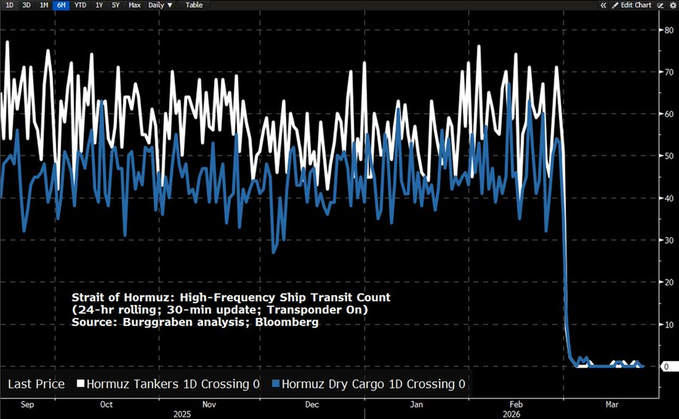
The payment rails are the real story. According to Bloomberg, Lloyd's List, and the Atlantic Council, tolls are being settled in Chinese yuan and cryptocurrency. Lloyd's confirmed at least two yuan-denominated transits brokered by Chinese maritime intermediaries. The Financial Times reported payments accepted in cash, crypto, or barter. Some reports cite stablecoins specifically, though the precise breakdown between yuan, stablecoins, and other crypto remains unclear given the opacity of the intermediary system.
What is clear is the direction: settlement at the world's most critical energy chokepoint is moving outside the dollar system. China's CIPS network saw daily transaction volumes spike to $134 billion in March, up from a steady $85 to $105 billion range, according to Atlantic Council analysis of CIPS data. The infrastructure to settle oil in yuan at scale already exists. Hormuz is where it gets stress-tested.
Stablecoins are not neutral money
Reports of crypto being accepted at the strait look like a win for the broader digital asset ecosystem. But the details matter.
Stablecoins are someone's liability. USDC is issued by Circle, a US-regulated entity. USDT's reserves sit primarily within the US banking system. Both issuers operate under legal frameworks that allow the US government to freeze, blacklist, or seize funds. Tether has frozen wallets at government request. Iran's own central bank halted the USDT-toman trading pair when the war began because the stablecoin was repricing the rial against the dollar in real time.
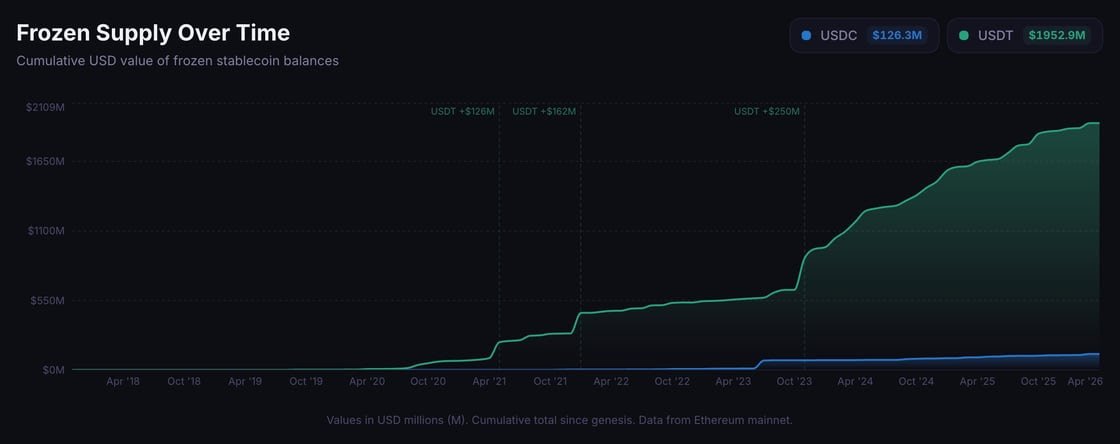
Stablecoins are tokenized dollar obligations. They inherit the dollar's utility and its political strings. For a sanctioned regime, they are a short-term workaround, not a durable solution. The moment Washington tightens enforcement, those rails close.
Bitcoin is structurally different. No issuer. No counterparty. No freeze function. Final settlement in under an hour, to anyone, anywhere, without permission. In a world where passage through a waterway is being priced in alternatives to the dollar, the distinction between a censorship-resistant bearer asset and a tokenized dollar obligation is not theoretical. It is operational.
Turkey & the limits of physical money
Turkey's central bank sold and swapped roughly 60 tons of gold, worth more than $8 billion, in two weeks following the start of the war, according to Bloomberg. The largest weekly reserve drawdown in seven years. Another $26 billion in foreign currency reserves were burned in the same period to defend the lira.
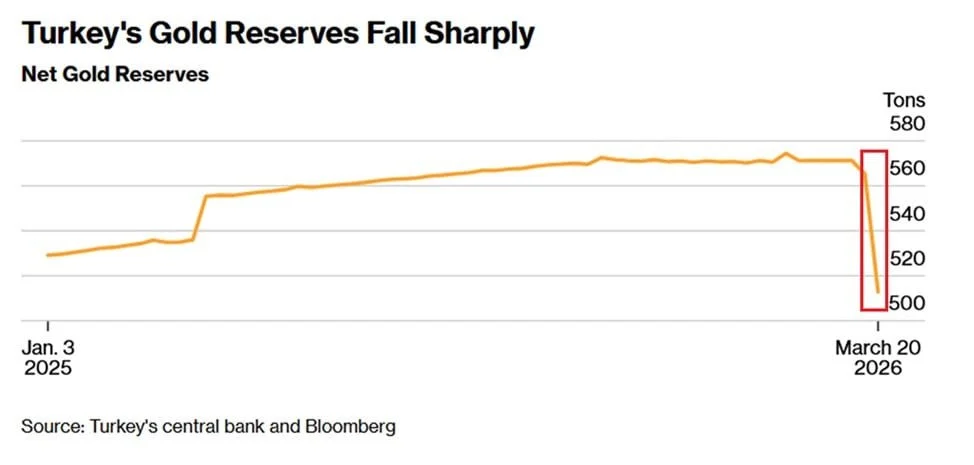
When you need dollars to meet dollar-denominated obligations and your currency is collapsing, gold is difficult to deploy. You swap it through intermediaries in London, convert to dollars, then deploy. Gold is a superb store of value. It is a slow and friction-heavy settlement instrument under pressure. You cannot send 60 tons of gold to a counterparty in minutes. You can send bitcoin to anyone, anywhere, with final settlement, in under an hour.
Sovereigns are already moving
Gold surpassed US Treasuries as the largest asset in global central bank reserves in mid-2025, the first time since 1996. As the BofA chart below shows, gold now represents roughly 24% of total central bank reserves versus 21% for US Treasuries. In the 2010s, those numbers were inverted: Treasuries peaked at 33% while gold sat near 9%. The crossover was driven by three consecutive years of 1,000+ ton annual gold purchases and gold's roughly 70% price gain in 2025.
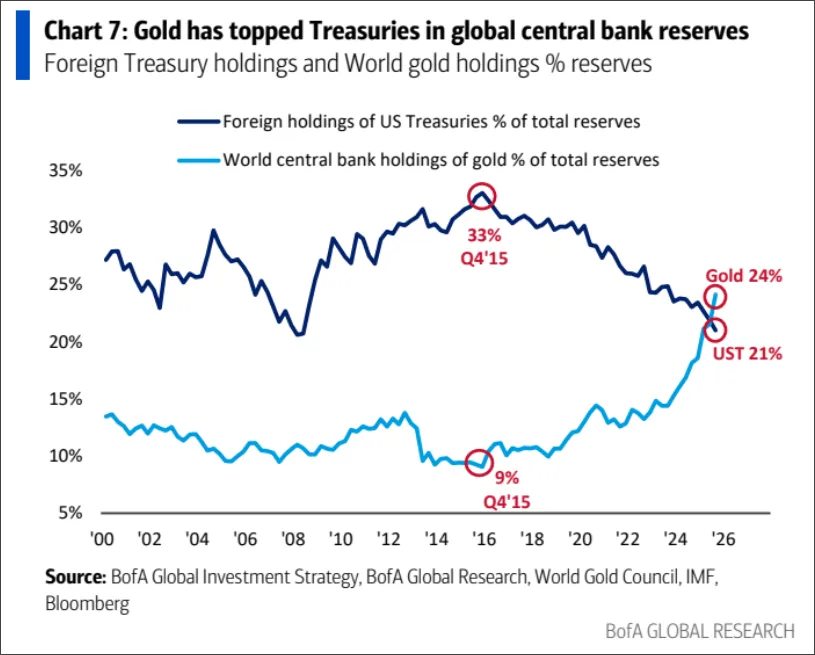
The conflict in the Middle East is accelerating both sides of this trade. Central banks have been net sellers of Treasuries since early 2025, and the decline has steepened since the war began. Foreign central bank holdings of Treasuries at the New York Fed have dropped from a peak above $3.1 trillion in 2021 to roughly $2.7 trillion, a drawdown of over $400 billion. The dollar's share of global FX reserves has declined from 71% in 2001 to about 58% today. A record 43% of central banks plan to increase gold holdings in 2026.
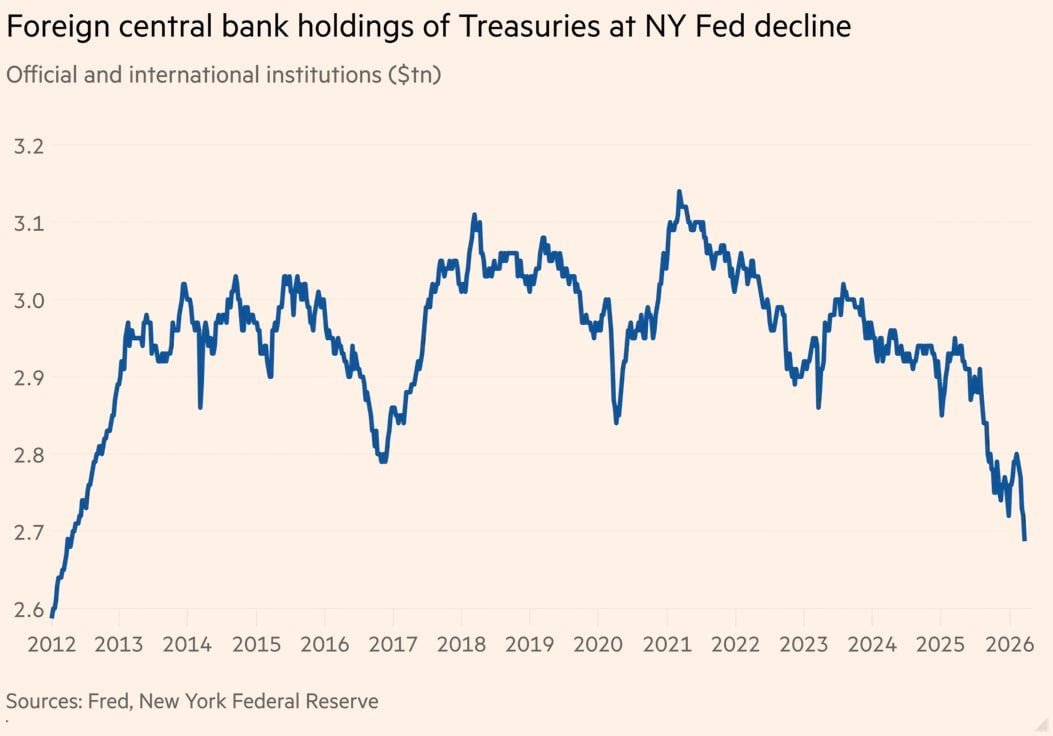
Sovereigns are rotating out of Treasuries and into neutral reserve assets. Gold is the incumbent. No issuer, no counterparty risk, three millennia of recognized value. But the past five weeks have exposed its limitations. It is hard to move, hard to settle with in real time, and under pressure, as Turkey showed, you end up converting it back into the very fiat system you were trying to escape.
Closing thoughts
Gold and bitcoin are money. Everything else is credit. Treasuries are the US government's liability. Stablecoins are an issuer's liability. Bank deposits are a bank's liability. The multipolar world emerging right now, where the US cannot guarantee safe passage through a strait, where BRICS nations are building parallel settlement systems, where sanctions have weaponized the dollar's own reserve infrastructure, demands neutral assets.
Gold serves that role in the physical world. Bitcoin serves it in the digital one. Gold is where sovereign reserves are headed near term because central banks already hold it, understand it, and are accumulating. Gold will continue to have its place. But bitcoin is the superior long-term settlement layer: digital, instantly transferable, globally accessible, with a fixed supply no central bank can debase when it faces a currency crisis.
The war in Iran is stress-testing the entire global settlement architecture. Who can transact with whom, in what currency, through what intermediary, with what counterparty risk. Every layer of that stack is being exposed in real time.
Chart Of The Week
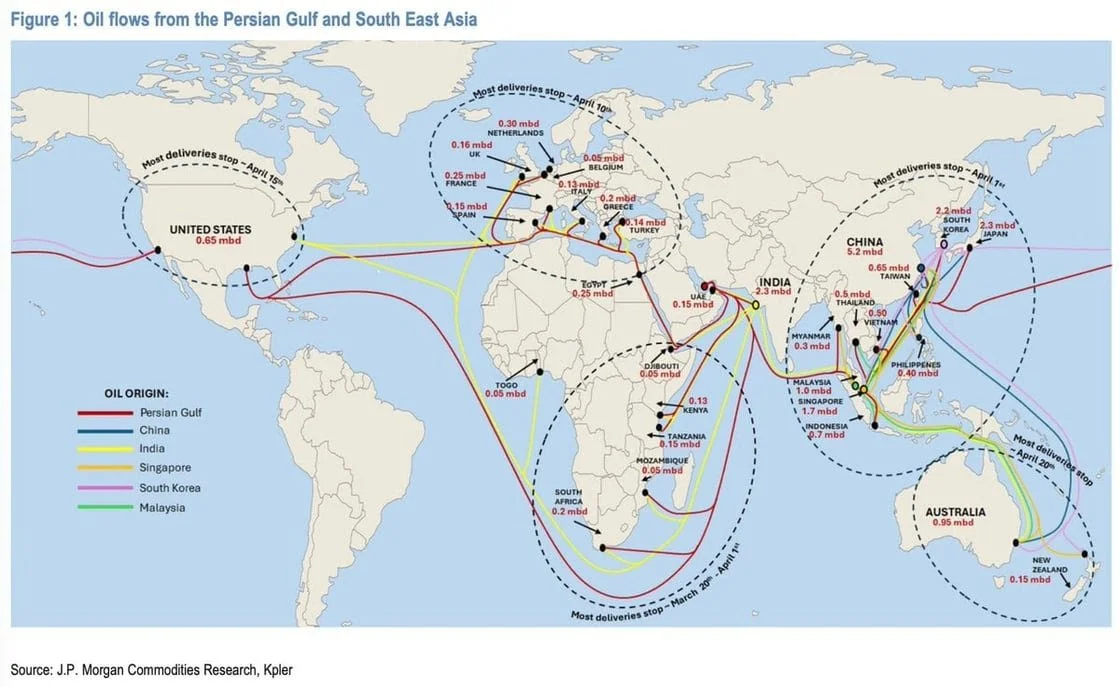
"I’ve been describing the supply loss from the closure of the Strait of Hormuz as an 'air pocket' moving through the normal flow of oil out of the Gulf. Helpful map from JPM highlighting when that air pocket will 'land' in different major consuming regions: East Africa last week, East Asia this week. Europe next week, North America two more weeks."
Quote Of The Week
"In a world where geopolitics are deteriorating, crony capitalism is rampant, the wealth gap continues to widen, and governments persist with endless money printing and mounting debt ... you must hold a single asset whose scarcity can be objectively proven. Ideally, a single asset that you can store yourself and trade without anyone’s permission."
Podcast Of The Week
Bitcoin For Professionals: The Money Truths Gen Z Refuses to Ignore
Gen Z is asking hard questions about money, the system, and the future of work.
Subscribe to Onramp MENA’s YouTube channel to catch new episodes of the Bitcoin For Professionals podcast!
Onramp MENA is an advisory and educational platform dedicated exclusively to Bitcoin.
If Onramp MENA’s offerings align with your needs, or those of someone you know, feel free to schedule a consultation with us here.