

Morgan Stanley Crosses the Rubicon
Before we get started…if you want to learn more about bitcoin – connect with the Onramp MENA team.
And now, for the weekly roundup…
Last week, Morgan Stanley filed with the SEC to launch the Morgan Stanley Bitcoin Trust. On the surface this looks like just another filing in a crowded room. The reality is much more meaningful.
The most telling detail isn’t in the S-1’s filing mechanics; it’s in the name. Morgan Stanley is not an ETF factory hunting for assets. They are one of the most powerful distribution engines in global finance.
The firm manages roughly 20 ETFs, but almost all of them sit behind sub-brands like Calvert, Parametric, or Eaton Vance. This bitcoin product will be only the third ETF in history to actually bear the "Morgan Stanley" brand.
When a firm with that specific DNA decides to stake its own brand reputation on a bitcoin wrapper, it provides some important signals:
Client demand is durable.
“Renting access” to competitors’ products has become too expensive to justify.
The reputational risk of not having a bitcoin strategy is now greater than the risk of having one.
This is not an experiment. You do not put the flagship brand on an experiment. You put it on a permanent revenue pillar.
From Distributor to Issuer
Morgan Stanley is arriving late to a commoditized market. You do not enter a race like this two years late unless the prize is massive.
This filing is an admission that the asset class has graduated. In October 2025 Morgan Stanley expanded crypto access across their client base. Filing as an issuer is the logical next step in that sequence. It moves them from a gatekeeper that tolls the bridge to an architect that owns the bridge.
They watched the flows. They watched the fees leave the building. Now they want to internalize the economics.
The Numbers That Forced Their Hand
If you want to understand why a conservative wealth giant would file for a spot bitcoin product in 2026 you simply have to look at the scoreboard.
BlackRock’s IBIT proved that the market was orders of magnitude larger than the skeptics believed.
The Scale: IBIT currently holds approximately $71.9 billion in net assets.
The Peak: In October 2025 the fund flirted with $100 billion in AUM.
The Speed: It reached these milestones faster than any ETF in history.
The broader complex tells the same story. With total category assets hovering near $124 billion and net inflows still hitting ~$700 million on strong days like we saw on Monday, the revenue pool is too large for a bank like Morgan Stanley to ignore.
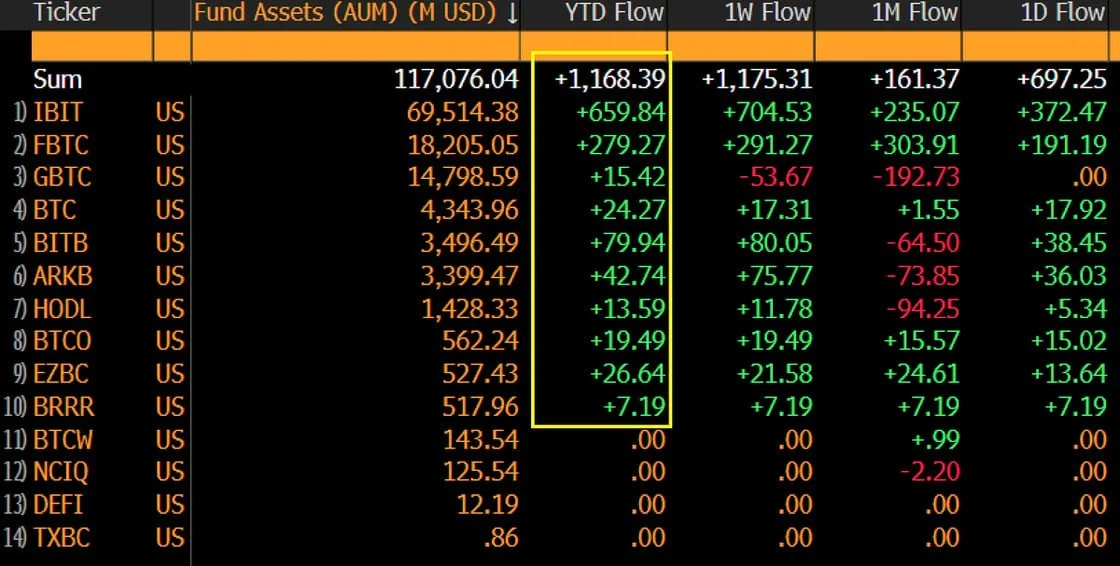
"The spot bitcoin ETFs are coming into 2026 like a lion, +$1.2b in flows in first two days of year w/ everyone eating. That's a $150b/yr pace. Told ya'll if they can take in $22b when it's raining, imagine when the sun is shining." — Eric Balchunas, Bloomberg Senior ETF Analyst
Why "Still Early" Is Accurate
The numbers are large but the structural integration is young.
The ETF wrapper solved access. It made bitcoin legible to the brokerage account. But wealth platforms move at committee speed. Approvals, model portfolio inclusion, and house views lag behind product launches by years. We are only just beginning to witness the shift from access to solicitation.
For the first two years, the story was about major platforms grudgingly allowing clients to buy these products if they asked. Now, the walls are coming down.
Bank of America / Merrill: As of last week, advisors can actively recommend allocations (1-4%) to bitcoin ETFs. This shifts the dynamic from “unsolicited only” to active sales.
Vanguard: Even the most stoic holdout has quietly opened the gates, allowing crypto ETFs on the platform after years of resistance.
Goldman Sachs: While not issuing a retail ETF yet, they are deeply embedded in the plumbing, acting as an Authorized Participant for the major funds.
Wells Fargo: Like Morgan Stanley, they dropped restrictions on advisor recommendations in late 2025.
This is the distinction that matters. Having a product on the shelf is one thing; having 15,000 wealth advisors actively pitching it to model portfolios is another. That machinery is only just turning on.
Morgan Stanley filing its own S-1 may be the loudest signal yet that the wirehouses are moving from passive accommodation to active competition.
Charts Of The Week
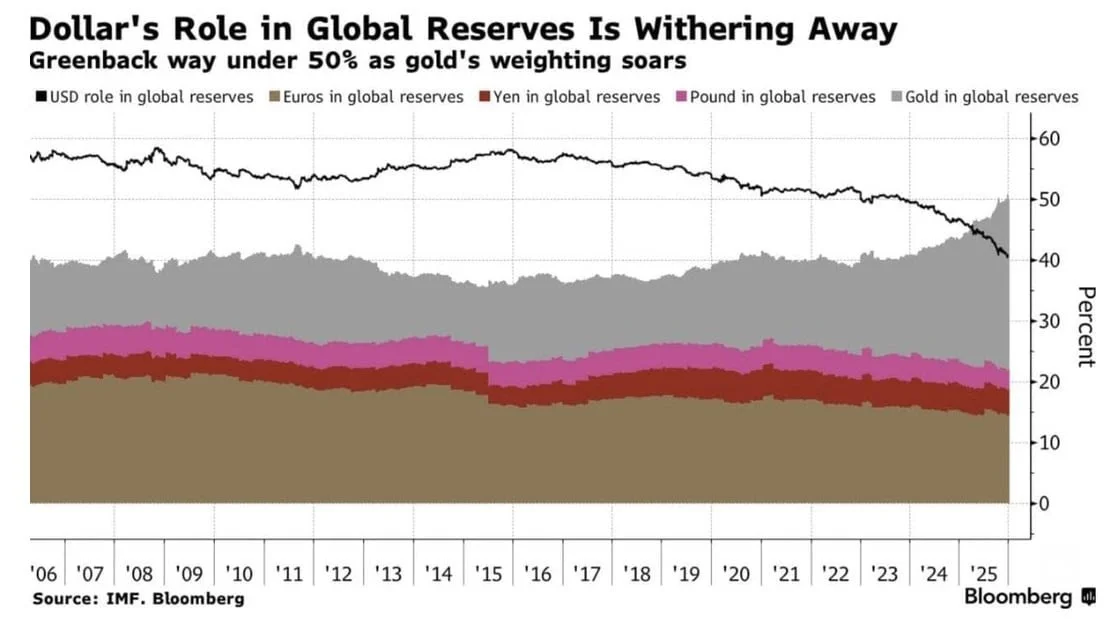
"Gold has overtaken the U.S. Dollar as the largest Global Reserve Asset."
— Barchart on X
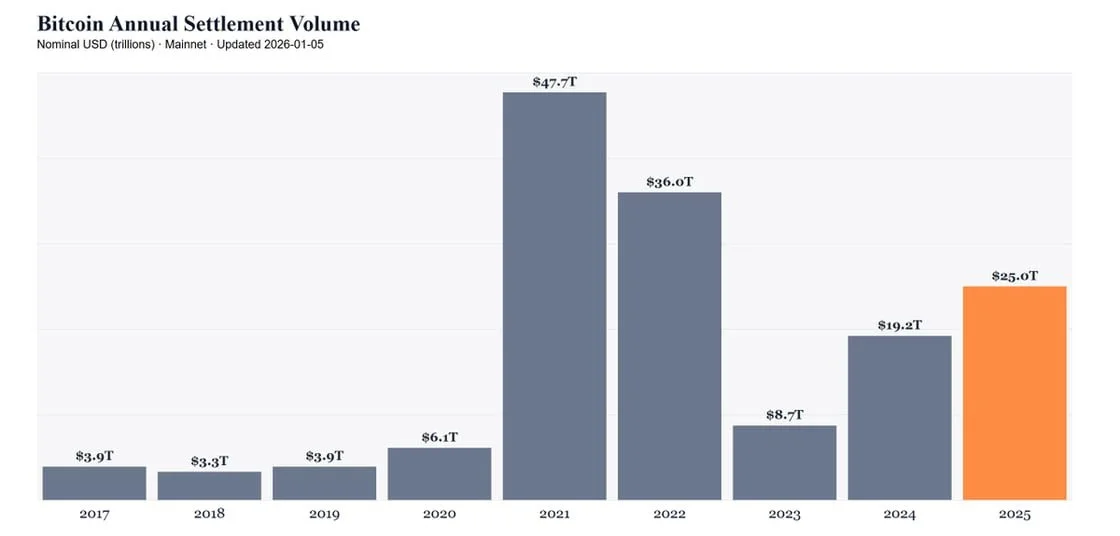
"Bitcoin network total gross settlement was $25 trillion in 2025. An astonishing achievement for monetary software technology that is only 17 years old. The experts said it was going to zero."
— Pierre Rochard on X
Quote Of The Week
"Just last year, The Atlantic wrote, “15 years into its existence, bitcoin has yet to demonstrate any serious use case.”
87% of humans today – though definitely no one who edits articles at The Atlantic – were born into a monetary system without a reserve currency, and also without democracy, rule of law, or property rights. Simply put, the way The Atlantic editors use money is not the way most people on earth use money, whose savings technology is either collapsing paper notes, cattle, or sheet metal.
Seething with financial privilege, The Atlantic editors might debate the relative merits of saving in NVDA vs. AMZN. How about, instead, cattle vs. sheet metal?
If bitcoin has no use case, perhaps The Atlantic editors should convert their entire life savings into Malawian Kwacha and see how it goes. In 2023, Malawi – generally considered a democratic country – chose a 44% overnight currency devaluation. And…it’s gone. If you don’t hold bitcoin, please step out of the line. This line is for people who have money. Not fiat credit.
No one got to vote on the inhuman cruelty of almost halving – overnight – the cumulative value of their entire life’s work. Instead, the criminal counterfeiters central bank forced The Atlantic editors 22 million humans to invest their life savings in unbacked pieces of paper with zero marginal production cost, turning them, ex-post, into 44% slaves. Nothing produced limitlessly and for free can ever, eventually, have value. Fiat is always and everywhere a ponzi phenomenon with seigniorage the State’s irresistibly silent Madoff-like pitch. Bitcoin, its kryptonite, will never take the meeting."
— Ross Stevens, Stone Ridge 2025 Shareholder Letter
Podcast Of The Week
Bitcoin For Professionals: Bitcoin Through the Eyes of a Whitehouse Insider
From the White House press room to refugee camps in Kenya, Bitcoin’s real story is not just about price or hype. It is about translation, education, and human reality.
Frank Corva shares what he’s seen at the true frontlines of adoption, and why Bitcoin’s future will be built gradually, and then suddenly.
Subscribe to Onramp MENA’s YouTube channel to catch new episodes of the Bitcoin For Professionals podcast!
Onramp MENA is an advisory and educational platform dedicated exclusively to Bitcoin.
If Onramp MENA’s offerings align with your needs, or those of someone you know, feel free to schedule a consultation with us here.