

Access Is Not Ownership
Before we get started…if you want to learn more about bitcoin – connect with the Onramp MENA team.
And now, for the weekly roundup…
Morgan Stanley flipped on spot trading for bitcoin at 50 basis points. The day before, Coinbase laid off 700 people. You can read those two stories separately, but you'd be missing the larger point.
Brian Armstrong's note to staff blamed AI and market sentiment. The truth nobody at HQ wants to say out loud is that they got distracted. The company that was supposed to be America's on-ramp to bitcoin spent the last few years chasing DeFi, web3, memecoins, prediction markets, and building out a casino floor for retail traders to grind their way to zero. They were trying to be everything, and the people who move real money in this country watched it happen and made other plans.
Now the wirehouses are at the door. E*Trade brings 8.6 million accounts. Morgan Stanley wealth advisors look after $9.3 trillion. Schwab, who launched their own spot product at 75 bps a few weeks ago, manages another ten trillion or so. Jed Finn, who runs wealth at Morgan Stanley, called the move "disintermediating the disintermediators." Eric Balchunas was more blunt:
"If I know Schwab, they likely won't let this stand. Others will prob undercut too. By the time the dust settles it'll be pretty dirt cheap to trade crypto everywhere, just as we saw with BTC ETF expense ratios prior to launch. This is why TradFi is no joke and crypto exchanges should be scared."
This is the arc of how financial products mature. Something new shows up, the early movers charge what they want, scale arrives, fees get crushed, and what looked like a product turns into a utility. The only thing different this time is how fast it's moving, and that's because the natives already built the rails. Morgan Stanley didn't have to invent any of this. They sat back, watched the regulatory perimeter firm up, and walked in carrying the one thing nobody at Coinbase can manufacture from scratch: a brand people trust and fifty years of distribution behind it.
Why now
Morgan Stanley didn't make this decision in a vacuum. They moved because the rules finally started to look like they'd hold.
A real federal framework for payment stablecoins, the GENIUS Act, was signed last summer and the proof showed up fast. The stablecoin market grew 49% in 2025 to $306 billion. Circle and Ripple grabbed provisional national bank charters from the OCC. Sidelined capital came back in. The recruiters who were placing senior crypto talent in the Caymans a year ago will tell you nine out of ten of their searches are back onshore. Turns out clear rules do what their advocates always said they would.
GENIUS handled the easy part. Clarity is the harder one: venue and intermediary registration, the SEC and CFTC carving up jurisdiction, custody rules, where the legal line sits for non-custodial software. The House passed it last summer, 294 votes. Then it sat in the Senate for the better part of a year because the bank lobby refused to let go of the stablecoin yield fight.
That broke a few days ago: Yield economically equivalent to a bank deposit is out, activity-linked rewards stay in. Coinbase, Circle, the trade groups all backed it inside a few hours. Senator Lummis said she's expecting markup the week of May 11 and that everything else is 99% sorted. Now there's a real path to a signed bill before August recess.
So when Morgan Stanley flipped the switch last week, they weren't out over their skis. They were reading the same political weather everyone else is and moving exactly when they thought they could. This is the same bank that implemented investment policy allocations for crypto at 4% in October. Six months later they're competing with BlackRock's IBIT and cutting Coinbase on price.
What's actually in the box
Spreads heading to zero. Spot fees heading to zero. MSBT, the spot bitcoin ETF Morgan Stanley launched a few weeks back, sits at 14 basis points and is the cheapest in the market. They came back last week and undercut everyone on the trading side too. The wrappers are becoming commoditized in real time.
But what lives underneath the surface matters more.
Every brokerage rolling out spot bitcoin this year is doing it the same way Coinbase has done it for a decade: omnibus custody. Your coins sit pooled with everyone else's in a wallet at a sub-custodian. Your "ownership" is a row in a brokerage database. Morgan Stanley's E*Trade product is using Zerohash for the liquidity, custody, and settlement. Schwab is doing their own thing. Coinbase is Coinbase. The plumbing varies. The structure is identical.
When you've got 1% of your net worth in bitcoin, none of this matters. Nobody loses sleep over how a rounding error gets custodied. At 10% you start asking real questions. At 50%+ the answer better be one you can defend to yourself.
Wealth platform allocations sit closer to 1% than 5% today. They're not going to stay there. And as that number climbs, the omnibus structure that was fine when the position was small stops being fine. The tradeoff that made sense at the bottom of the allocation gets harder to justify as exposure grows. None of the new entrants are going to solve that for anyone, because they're all using the same structure that's becoming rapidly commoditized.
This is the lesson Coinbase is sitting in the middle of right now. Take your eye off the most important asset, build the casino, and you end up exposed on the one thing you were supposed to be best at. The wirehouses arriving in your market are going to copy your playbook (same omnibus structure, brokerage statement ownership, spot bitcoin sold next to a hundred other things) and they're going to do it cheaper because they have a real balance sheet to absorb the margin compression.
Legitimacy is settled. The wirehouses settled it with their balance sheets, Congress is about to settle it in writing, and bitcoin is back over $80,000. The next question is harder. Not where do I buy bitcoin, but what do I actually own on a given platform.
Multi-Institution Custody is the answer we built for that question. Three independent institutions, 2-of-3 multisig vault, segregated and verifiable on-chain. No single party can move funds. No single party can lose funds. You hold bitcoin with greater ownership assurances than you would with any single custodian on the market.
That's the difference between getting access to bitcoin and actually owning it. The first one is what the wirehouses are selling. The second one is what's going to matter five years from now.
Chart Of The Week
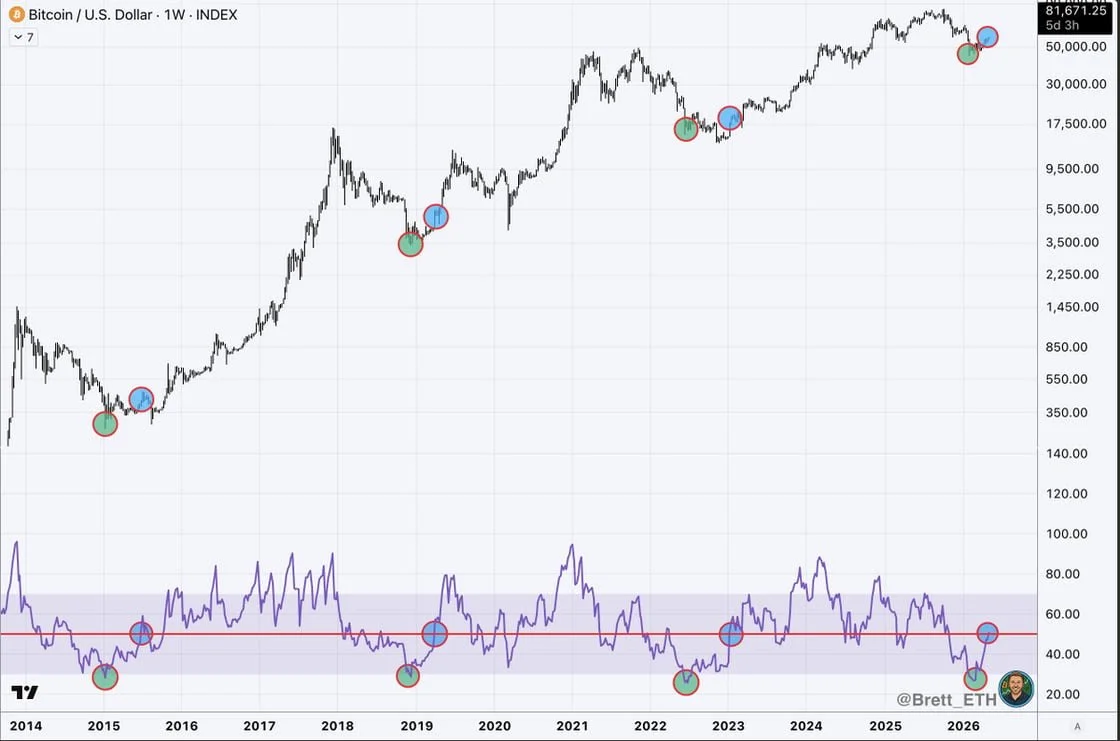
"Bitcoin's weekly RSI has only been below 30 and back above 50, four times, ever. And it just did it again. Each time this has occurred, the bottom was in."
Quote Of The Week
"Imagine waiting for a catalyst once you understand the fundamental value prop of bitcoin. Stay humble, stack sats."
Podcast Of The Week
Bitcoin For Professionals: How He Plans To Onboard 100 Million People To Bitcoin By 2030
How does a maths and physics teacher turned entrepreneur, onboard 100 million people to Bitcoin by 2030?
Subscribe to Onramp MENA’s YouTube channel to catch new episodes of the Bitcoin For Professionals podcast!
Onramp MENA is an advisory and educational platform dedicated exclusively to Bitcoin.
If Onramp MENA’s offerings align with your needs, or those of someone you know, feel free to schedule a consultation with us here.