

The Gates Are Closing
Before we get started…if you want to learn more about bitcoin – connect with the Onramp MENA team.
And now, for the weekly roundup…
Private Credit's Liquidity Illusion Shatters as Wall Street's Biggest Funds Lock the Exits
In the past three weeks, five of the largest private credit funds in the world have either halted, restricted, or gated investor redemptions.
Blue Owl permanently shut quarterly withdrawals from its $1.6 billion OBDC II fund.
Blackstone saw a record $3.7 billion in redemption requests from its $82 billion BCRED fund, forcing it to raise its quarterly cap and inject $400 million of its own capital.
BlackRock capped withdrawals from the $26 billion HPS Corporate Lending Fund at 5% after investors requested 9.3% back.
Cliffwater's $33 billion flagship saw requests hit 14% this week, capped at 7%.
And just yesterday, Morgan Stanley disclosed that its North Haven Private Income Fund returned only 46% of what investors asked to withdraw.
What looked like an isolated incident three weeks ago now has the unmistakable shape of a pattern.
Meanwhile, JPMorgan began marking down the value of software loans held as collateral by private credit firms, reducing borrowing capacity across the sector. Jamie Dimon has been warning about "cockroaches" in private credit for months. Today, the bank put its balance sheet where his mouth is.
Why Now
The vulnerabilities have been building for years. What changed is that multiple catalysts arrived at once, and each one amplifies the others.
Interest rates came down 175 basis points from their peak but remain dramatically higher than the near-zero world in which most of this debt was originated. Private credit loans are predominantly floating-rate. Borrowers have been absorbing elevated costs for three years, eroding cash flow and pushing interest coverage ratios to 2.1x on average versus 3.9x in public markets. The higher-for-longer regime did not cause instant defaults. It caused a slow bleed, and the bleed is now surfacing at the fund level.
The Iran conflict accelerated the timeline. Operation Epic Fury has produced the largest oil supply disruption in history, roughly 20% of global supply offline through the Strait of Hormuz. Brent has surged near $120 earlier this week. The February jobs report showed 92,000 cuts. Recession odds have spiked.
For private credit, war is a gut punch on two fronts: it deteriorates borrower fundamentals through rising input costs and weakening demand, and it triggers the flight-to-safety reflex that drives redemptions. Investors want cash and discover that their "semi-liquid" funds are anything but.
Artificial Intelligence disruption is the sector-specific accelerant. Software companies represent 25-40% of private credit loan portfolios. AI tools are repricing the durability of SaaS recurring revenue. A record $25 billion in speculative-rated software loans were trading below 80 cents on the dollar as of January. JPMorgan's collateral markdowns yesterday formalize what the market already knows.
And tariff-driven sticky inflation at 2.9% keeps the Fed on pause, which keeps rates elevated, which keeps borrower pressure building. A closed loop with no easy exit. None of these forces alone would crack the system. Their convergence is what makes this moment different.
The Structure & the Rot Beneath
The private credit market sits at roughly $2 trillion, up from $40 billion at the millennium. After 2008, regulation pushed banks out of riskier lending and non-bank vehicles filled the void. The trade was simple: originate floating-rate loans to middle-market companies, promise investors periodic liquidity, collect fees on an ever-growing base.
The periodic liquidity was always fiction. These funds offer quarterly tender windows capped at 5% of shares, but the underlying loans are illiquid bilateral agreements with three-to-seven-year maturities. They cannot be sold on demand without significant price impact. When everyone wants out at once, the math breaks.
The rot runs deeper than redemption pressure. Lincoln International reports that "shadow default" rates, measured by "bad PIK" (payment-in-kind) provisions (where borrowers pay interest with more debt because they lack the cash), have more than doubled since 2021 to 6.4% of all deals. The IMF found roughly 40% of private credit borrowers now have negative free cash flow. Public BDCs (Business Development Companies) receive nearly 8% of investment income via PIK. The borrower appears current. No actual money is changing hands.
The DOJ has issued warnings about "creative" accounting masking what are effectively defaults. Boaz Weinstein of Saba Capital, now buying fund stakes at 35% discounts to NAV, put it plainly: the problems are "multiplying by the quarter" due to the "financial alchemy of promising liquidity that isn't there."
Who Holds the Bag
According to the Federal Reserve, pension funds hold roughly 31% of private credit fund assets. Insurance companies hold about 9%. Retail and high-net-worth investors are the fastest-growing cohort, pouring into non-traded BDCs that exploded from zero in 2021 to over $200 billion today.
This creates cascade risk far beyond Wall Street. Pension losses flow to the retirement security of teachers, firefighters, and municipal workers. In Germany, the VZB pension fund lost €1.1 billion, half its assets, from concentrated private credit bets. Members are demanding a government rescue. Insurance companies facing writedowns may be forced to sell liquid assets to meet claims or capital requirements, transmitting contagion into public markets.
The UBS chairman warned in late 2025 that insurers shopping for favorable private credit ratings were creating "looming systemic risk" reminiscent of 2008. Retail investors in Blue Owl's OBDC II were promised quarterly liquidity and got a permanent gate and capital returned on a timeline they do not control.
The cascade logic is simple. Pensions reduce allocations. Insurers tighten. Retail flees. Banks pull credit lines. Each response reduces capacity across the sector precisely when funds need liquidity most, a self-reinforcing cycle that can accelerate from repricing to forced selling very quickly.
Rhymes with 2008
The parallels are imperfect but instructive. Before 2008, the system created instruments believed to be safe, rated by conflicted agencies, held by institutions that did not understand the risk, sold to investors promised liquidity that vanished when it mattered. On August 9, 2007, BNP Paribas froze redemptions for three funds, citing inability to value their structured products. It was the moment the system admitted liquidity was an illusion.
Today's private credit shares the key features: opaque assets valued by models not markets, dense interconnections between funds, banks, insurers, and pensions that are poorly mapped, and retail investors brought in late on the promise of safe yield. The critical difference is scale. But the direction of travel is what matters. The same post-2008 rules that fortified banks pushed risk into the shadows, into exactly the vehicles now gating redemptions.
Why Bitcoin Was Built for This Moment
On January 3, 2009, Satoshi Nakamoto mined the genesis block and embedded a message: "The Times 03/Jan/2009 Chancellor on brink of second bailout for banks." It was a thesis statement. Bitcoin was born as a direct response to the opacity, counterparty risk, and broken trust that the fiat system keeps producing.
Private credit lives and dies by mark-to-model, where the people marking the assets are the same people paid to manage them. Bitcoin is mark-to-reality. The ledger does not negotiate.
The crisis stems from the gap between promised liquidity and actual illiquidity. Bitcoin has no counterparty. Settlement is final. There is no gate.
The ecosystem is layered with hidden leverage. Bitcoin's monetary policy is fixed, transparent, and algorithmically enforced. 21 million. No creative accounting. When BlackRock caps redemptions, when Morgan Stanley returns less than half, when Blue Owl shuts the exit, these are centralized decisions about your capital.
Bitcoin gives holders something no private credit fund, no BDC, and no quarterly tender offer ever will: genuine sovereignty over their own capital. Through native multisig, custody can be distributed across multiple independent parties so that no single point of failure exists. The protocol enforces your property rights, unconditionally.
The gates are closing across private credit. For investors caught inside, the lesson is painful: liquidity that depends on someone else's willingness to provide it is not liquidity at all. It is a promise. And promises break under stress.
Bitcoin does not make promises. It enforces rules. In moments like this, that is the only difference that matters.
Chart Of The Week
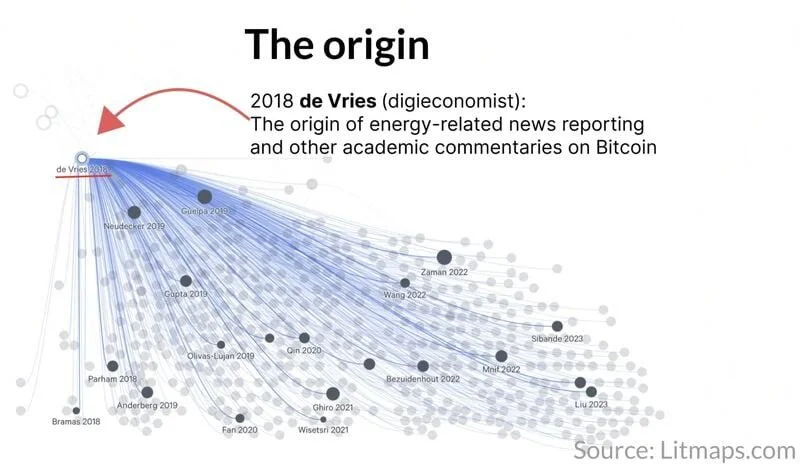
"Litmaps, a powerful research tracking tool, reveals that patient zero for all junk science on Bitcoin's environmental impact was a single 6 page "commentary" by Alex de Vries. (A commentary in the context of an academic journal means a short opinion piece that does not to go through a full peer-review process and which does not use novel empirical data).
The method he used to claim that Bitcoin's environmental damage was a growing concern was his fundamentally flawed "energy use per transactions" method (Bitcoin energy use does not come from its transactions, therefore it can scale transaction volume exponentially without increasing emissions)."
Quote Of The Week
"You can't flee a war zone with gold, so you're forced to sell at a discount (if you're lucky enough to find a buyer). Then figure out how to get that fiat abroad. Meanwhile you can cross a border with millions worth of Bitcoin in your head by memorizing 12 words. Bitcoin price aside, that is a true innovation."
Podcast Of The Week
Bitcoin For Professionals: Switzerland, Decentralization & Bitcoin’s Marketing Power
How does Bitcoin grow without a CEO, PR team, or ad budget?
Subscribe to Onramp MENA’s YouTube channel to catch new episodes of the Bitcoin For Professionals podcast!
Onramp MENA is an advisory and educational platform dedicated exclusively to Bitcoin.
If Onramp MENA’s offerings align with your needs, or those of someone you know, feel free to schedule a consultation with us here.